
DPDP Compliance in India: What the DPDP Act and DPDP Rules Mean for Your Business, and How to Get Ready Before May 2027
Book a DPDP Readiness AssessmentWhy DPDP Compliance Is Now a Board-Level Priority
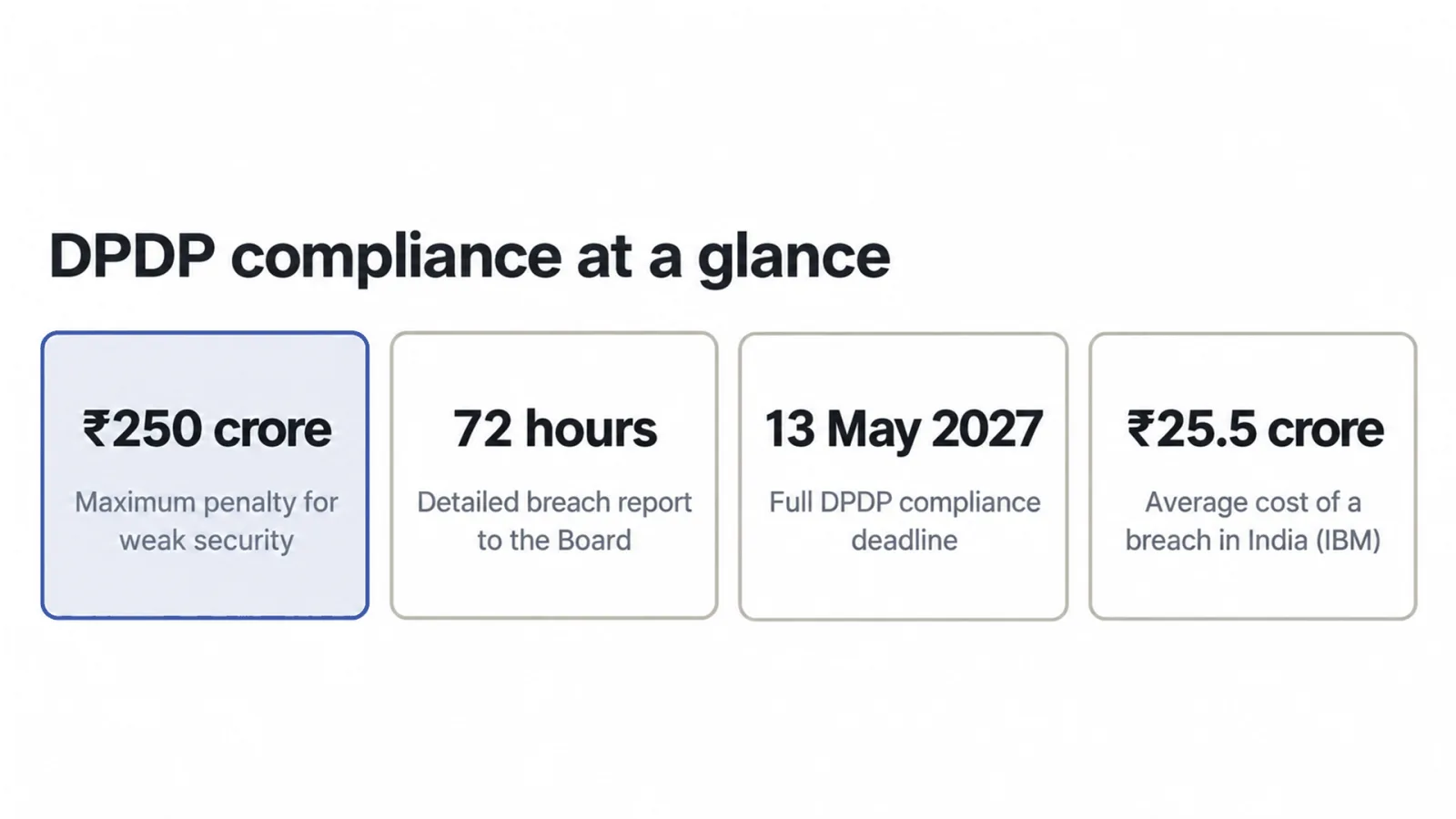
DPDP compliance is no longer a 2027 problem. India’s Digital Personal Data Protection framework switches on in stages: the Consent Manager rules take effect on 13 November 2026, and almost every operational duty, from consent and security to breach reporting, becomes enforceable on 13 May 2027. That leaves most businesses one budget cycle to get ready.
The financial stakes have changed too. The IBM Cost of a Data Breach Report 2026 puts the average cost of a breach in India at a record ₹25.5 crore, up 15.9% in a year. That figure is before a single rupee of DPDP penalty, which can reach ₹250 crore per instance.
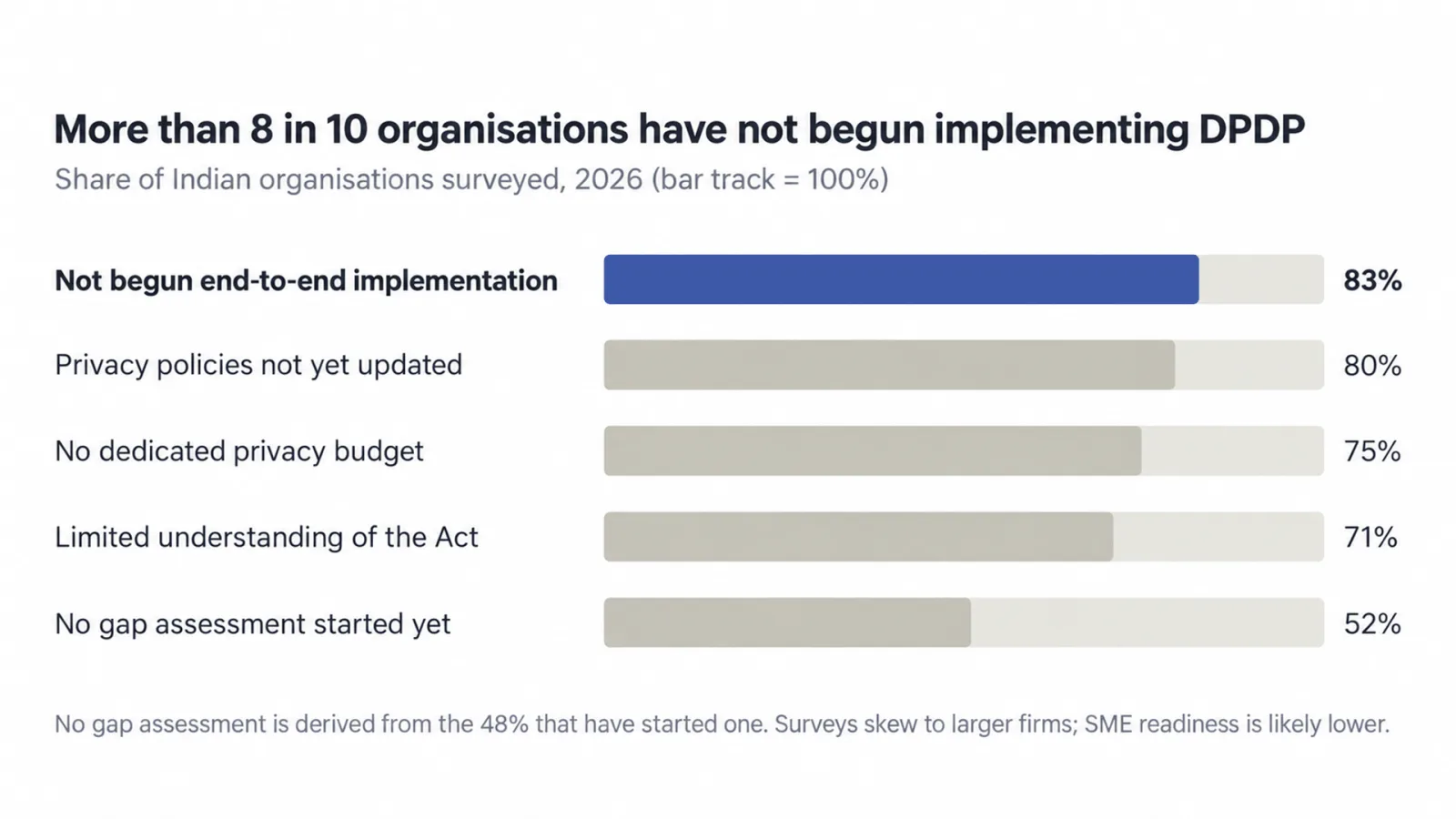
Yet most of India Inc is still at the starting line. An EY survey found that more than 83% of organisations had not begun end-to-end implementation across their systems and processes.
Having sat on both sides of the table, in finance and in technology, I see the same mistake repeated. Businesses hand DPDP to the legal team, receive a new privacy policy, and consider the job done. But the largest penalty in the Act is not for a badly worded notice. It is for failing to keep data secure, and that is an IT failure. Policies don’t stop breaches; controls do.
This guide explains what the DPDP Act and DPDP Rules require, what non-compliance costs, and a practical roadmap for getting compliant before May 2027. It is written for two readers: the owner or CFO who must approve the budget, and the IT head who must make it work.
Key Takeaways
- Deadlines: Consent Manager rules from 13 November 2026; full DPDP compliance from 13 May 2027.
- Maximum penalty: up to ₹250 crore per instance for failing to take reasonable security safeguards.
- Breach reporting: inform the Data Protection Board and every affected person without delay, with a detailed report to the Board within 72 hours.
- The real work is IT: encryption, access control, logging, backups and vendor controls carry most of the compliance burden, and the heaviest penalties.
- Your first step: map where personal data lives across your systems, devices and vendors. You cannot protect what you cannot find.
What Is the DPDP Act? The Digital Personal Data Protection Act Explained
The DPDP Act received Presidential assent in August 2023. It sets the principles. The DPDP Rules, 2025, notified by the Ministry of Electronics and Information Technology (MeitY) in November 2025, supply the operating detail: what a notice must contain, which security safeguards are expected, and how fast a breach must be reported.
Who Does the DPDP Act Apply To?
The Act applies to any organisation that processes digital personal data in India. That includes data collected digitally, and data collected on paper and digitised later. It also applies to processing outside India when it relates to offering goods or services to people in India. An Indian SaaS company, a Raipur steel plant with 800 employees and a foreign e-commerce site selling into India are all covered.
There is no turnover or headcount threshold. If your business holds names, phone numbers, email addresses, PAN details, salary records or bank details of identifiable people, the Act applies to you.
What the DPDP Act Does Not Cover
- Personal data processed by an individual for purely personal or domestic purposes.
- Personal data that the individual has made publicly available, or that is made public under a legal obligation.
- Non-digital data that is never digitised.
Unlike Europe’s GDPR, the DPDP Act has no separate category of “sensitive” personal data. A customer’s phone number and an employee’s salary slip carry the same legal protection. This simplifies classification, but it also means no data set can be treated as low-stakes.
How the DPDP Regime Changes the Old Rules
Until now, Indian data protection rested on Section 43A of the IT Act, 2000 and the SPDI Rules, 2011. The table shows what changes.
| Aspect | IT Act Section 43A and SPDI Rules | DPDP Act and DPDP Rules |
|---|---|---|
| Scope | “Sensitive” personal data only | All digital personal data |
| Consequence of failure | Compensation to affected persons | Penalties up to ₹250 crore per instance |
| Regulator | None dedicated | Data Protection Board of India |
| Breach reporting | CERT-In only | Data Protection Board and every affected person |
| Individual rights | Limited | Access, correction, erasure, nomination and grievance redressal |
| Cross-border transfers | Largely unregulated | Permitted, except to countries the Government restricts |
Note: the SPDI Rules continue to govern consent, notice, rights and security until the DPDP’s substantive provisions commence in May 2027. Until then, businesses have obligations under both regimes, and the transition period is not a compliance vacuum.
Key DPDP Terms Every Business Must Know
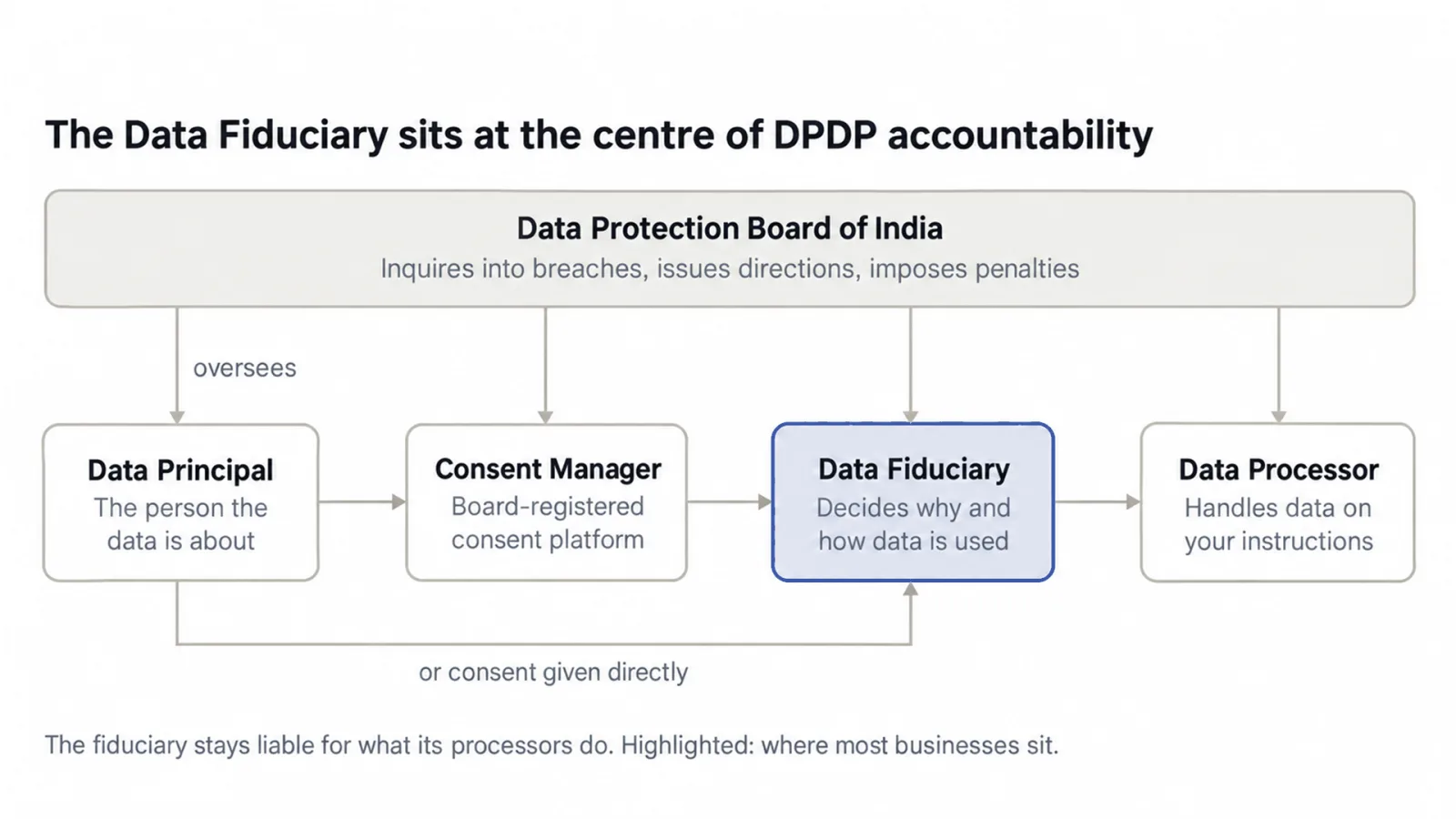
The DPDP Act assigns obligations by role, not by industry. So start by asking one question: what role do we play with this data? Most businesses are a Data Fiduciary for their own customer and employee data, and a Data Processor when they handle data for clients.
| Term | Plain-English meaning | SME example |
|---|---|---|
| Data Principal | The individual the personal data belongs to. For a child or a person with a disability, this includes the parent or lawful guardian. | A customer, an employee, a job applicant |
| Data Fiduciary | The organisation that decides why and how personal data is processed. It carries primary legal responsibility. | A manufacturer holding customer and payroll records |
| Data Processor | An organisation that processes personal data on behalf of a Data Fiduciary. | A payroll vendor, a cloud host, a CRM provider |
| Consent Manager | A Board-registered platform through which individuals give, manage, review and withdraw consent across businesses. | An Indian company registered under Rule 4 |
| Significant Data Fiduciary (SDF) | A fiduciary the Government designates for heavier duties, based on data volume, sensitivity and risk. | Large platforms, banks, insurers |
| Data Protection Board of India | The adjudicating body that inquires into breaches, issues directions and imposes penalties. | Receives complaints and breach intimations |
One practical point for CFOs: becoming a Data Processor does not move liability off your books. Under the Act, the Data Fiduciary remains responsible for whatever its processors do with the data. Your vendor contracts are therefore part of your risk position.
DPDP Rules 2025: What Changed and When Each Rule Applies
The Three-Phase Rollout
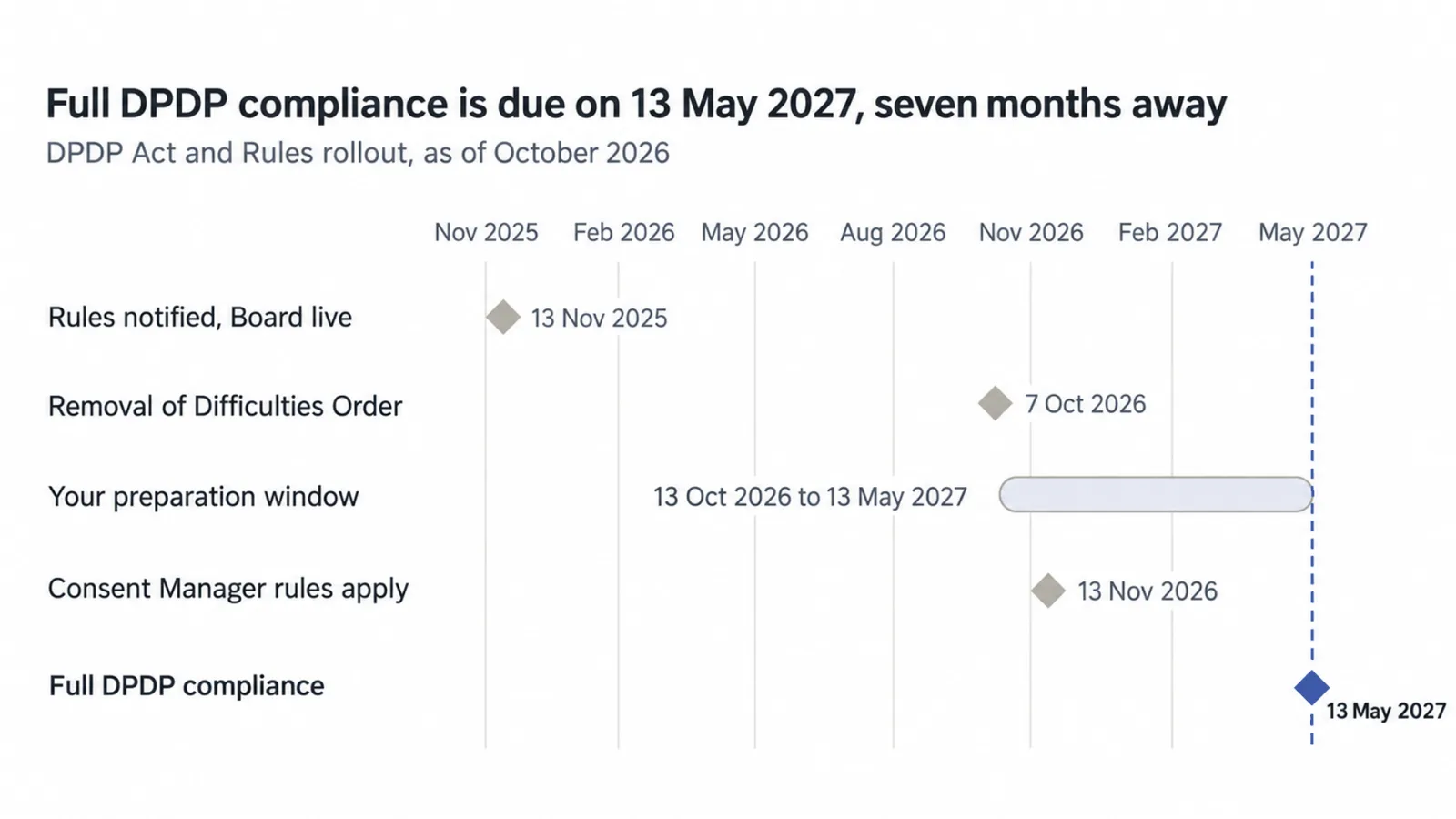
| Phase | Date | What applies | What your business should be doing |
|---|---|---|---|
| 1 | 13 Nov 2025 | Rules 1, 2 and 17–21: definitions and the Data Protection Board | Appoint an owner, start the gap assessment |
| 2 | 13 Nov 2026 | Rule 4: registration and duties of Consent Managers | Review your consent architecture and records |
| 3 | 13 May 2027 | Rules 3, 5–16, 22 and 23: notice, consent, security safeguards, breach reporting, retention, children’s data, SDF duties, data principal rights | Be fully compliant, with evidence |
The Rules were notified on 13 November 2025 and published in the Gazette on 14 November 2025, so some sources cite 14 May 2027 as the final date.
The phasing is deliberate. The Government has given businesses 18 months because the heavy work, such as rebuilding consent flows, deploying security controls and renegotiating vendor contracts, takes time. A business that starts in March 2027 will not finish by May.
Latest Development: The DPDP (Removal of Difficulties) Order 2026
MeitY issued the DPDP (Removal of Difficulties) Order, 2026 on 5 October 2026, and it was published in the Gazette on 7 October. It makes two textual clarifications to the Act.
- The first fixes how the Act words the rules on children’s data and the data of persons with disabilities.
- The second changes “audit” to “data audit” in the duties of Significant Data Fiduciaries.
The Order creates no new compliance obligations. What it does signal is that the Government is actively tidying the framework ahead of enforcement, not slowing it down. Businesses that may be designated as SDFs should update their audit plans to reflect the “data audit” wording.
Why Significant Data Fiduciaries Cannot Wait for 2027
In January 2026, MeitY sought industry views on accelerating DPDP implementation, including a proposal to shorten the compliance window from 18 months to 12 months, particularly for large data fiduciaries. Officials said no final decision had been taken. If the proposal is adopted, large enterprises could face substantive duties as early as November 2026. Prudent boards are planning to the earlier date.
Core DPDP Compliance Obligations, Explained
1. Notice and Consent Requirements
Most businesses already ask for consent. The real question is whether that consent would hold up under the DPDP Act. Consent must be free, specific, informed, unconditional and unambiguous, given through a clear affirmative action, and limited to the data needed for the stated purpose. Withdrawing consent must be as easy as giving it.
Under Rule 3, the notice must stand on its own, not be buried in your terms and conditions. It must be in clear, plain language and give an itemised description of the data collected and the specific purpose. It must also include a link to withdraw consent, exercise rights and complain to the Board. The individual can ask for the notice in English or any of the 22 languages in the Eighth Schedule of the Constitution.
| Valid consent | Invalid consent |
|---|---|
| An unticked box the user actively ticks | A pre-ticked box |
| Separate consent for each purpose (orders, marketing) | One blanket consent for “business purposes” |
| Service still available if marketing is declined | Service refused unless every purpose is accepted |
| A one-click withdrawal link in the app or email | Withdrawal only by a written letter |
| A standalone notice in plain language | Consent hidden in clause 47 of the terms |
For data collected before the Act took effect, you may continue processing, but you must send a fresh notice as soon as reasonably practicable. Individuals can then withdraw consent.
2. Employee Data: What the Employment Carve-Out Does and Doesn’t Cover
Many businesses assume employee data falls outside the purview of the DPDP Act. It doesn’t.
What the Act does is give employers one concession. Under Section 7(i), the employer is not required to seek an employee’s consent to use their data for employment purposes. That covers the everyday work of running a business:
- running payroll
- tracking attendance
- controlling access to offices and systems
- making statutory filings
- protecting confidential business information
So the employer can skip the consent step. However, the responsibility to protect the data, report any breach, and delete it when no longer needed will still be with the employer. Whatever the reason you hold the data, the duties in Section 8 still apply:
- reasonable security safeguards for HR and payroll systems (Section 8(5))
- breach reporting if employee data is compromised (Section 8(6))
- erasure once the purpose is served and no law requires retention (Section 8(7))
- valid contracts with payroll, HRMS and background-verification vendors
A point for HR heads: employees do not have the same data rights as customers
Sections 11 and 12 of the DPDP Act cover these rights.
The wording of these sections is important. It ties the rights to two situations: data processed with the person’s consent, and data the person handed over voluntarily under Section 7(a). It does not mention data processed for employment purposes under Section 7(i).
As a result, an employee does not have the same clear right as a customer to see or erase their data. The right to raise a grievance still applies to everyone.
The courts and the Data Protection Board have not yet ruled on this point. Before you turn down an employee’s request on this basis, check with your legal adviser.
A caution on monitoring employees
The employment carve-out does not allow unlimited monitoring of staff. It covers what is needed to run the employment relationship and protect the business.
Some employers have added broad surveillance clauses to employment contracts and labelled them as employment purposes. Legal commentators have questioned whether such clauses are valid under the DPDP Act.
The safer approach is to monitor only for a clear security reason. Write that reason down. Limit monitoring to company devices and systems. Tell employees what you monitor and why.
3. Purpose Limitation, Retention and Erasure
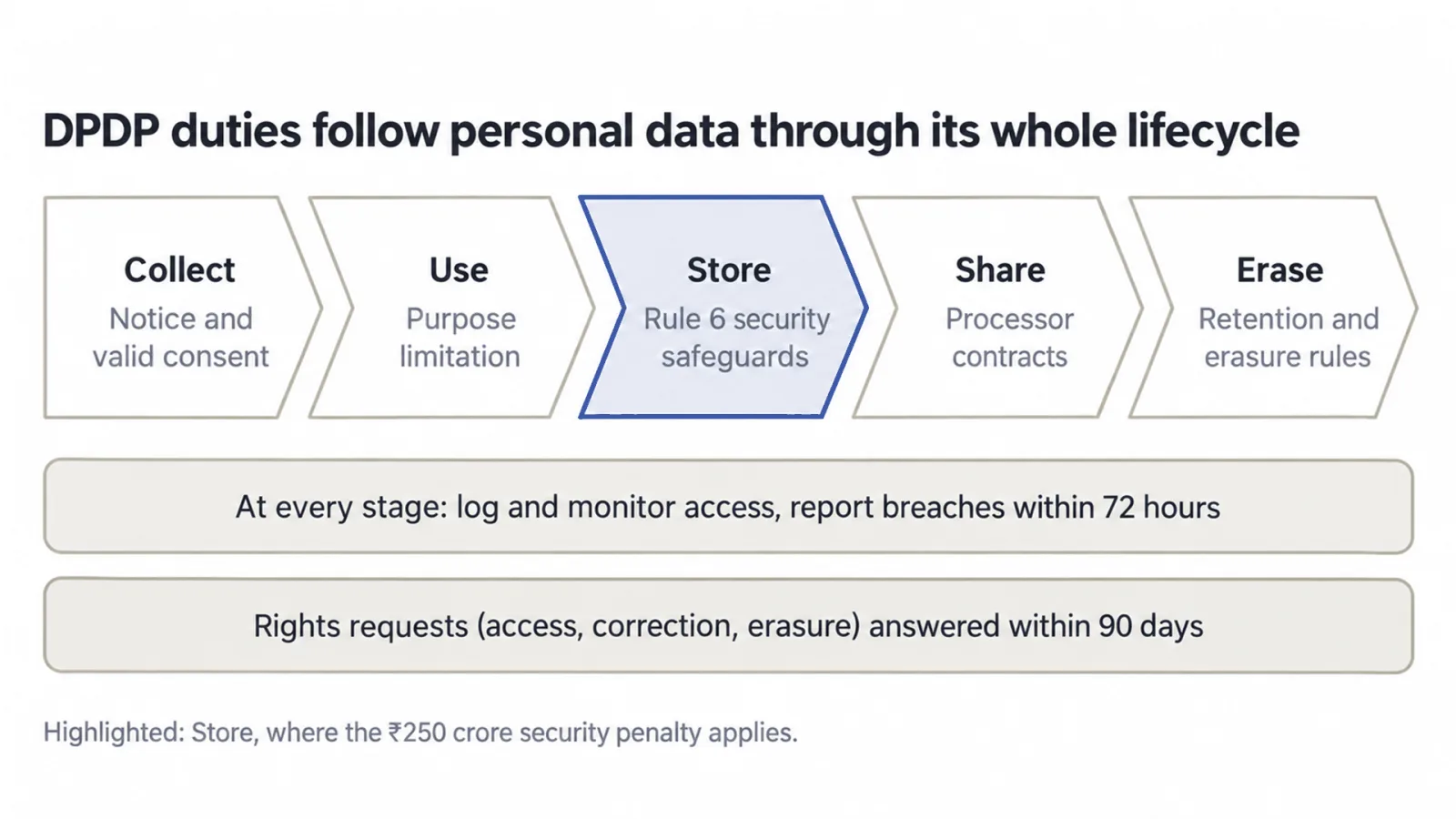
Personal data may be kept only as long as its purpose requires, unless a law demands longer retention. Your GST, Companies Act and labour-law retention periods still apply. Once the purpose ends, the data must be erased, and your processors must erase their copies too.
Two specific rules apply:
- Minimum retention of logs (Rule 8(3)): fiduciaries must keep personal data, associated traffic data and processing logs for at least one year, for purposes such as investigation and regulatory requests.
- Inactivity erasure (Rule 8 and the Third Schedule): large e-commerce platforms, online gaming intermediaries and social media intermediaries must erase data of users inactive for three years, after giving 48 hours’ notice. Most SMEs fall below these thresholds, but the principle of defined retention applies to everyone.
For IT teams, this is a data-engineering task. Erasure must reach production databases, backups, email archives, shared drives and vendor systems.
4. Reasonable Security Safeguards (Rule 6)
This is where DPDP becomes an IT programme, and where the heaviest penalty sits. Section 8(5) requires every fiduciary to take reasonable security safeguards to prevent personal data breaches. Rule 6 sets out the minimum.
| Rule 6 requirement | What it means in your IT environment |
|---|---|
| Encryption, obfuscation, masking or virtual tokens | Encrypt data at rest and in transit. Mask PAN, Aadhaar and bank fields in Tally, ERP and HRMS. Encrypt laptops and backups. |
| Access control | Role-based access, multi-factor authentication, removal of access when staff leave, control of privileged accounts |
| Visibility through logs, monitoring and review | Centralised logging of access to personal data, alerts on unusual activity, regular review |
| Continuity, including backups | Tested backups kept separate from production, so a ransomware attack doesn’t take your recovery copies with it |
| Retention of logs for one year | Log storage sized and protected for at least 12 months |
| Security clauses in processor contracts | Every vendor handling your data is bound to equivalent safeguards |
| Appropriate technical and organisational measures | Policies, training and periodic testing that show the controls actually work |
Note the word “reasonable”. The Board will judge your safeguards against your size, the volume and nature of data you hold, and what a prudent organisation would do. An unencrypted laptop containing 50,000 customer records is unlikely to be judged reasonable in 2027.
5. Personal Data Breach Notification
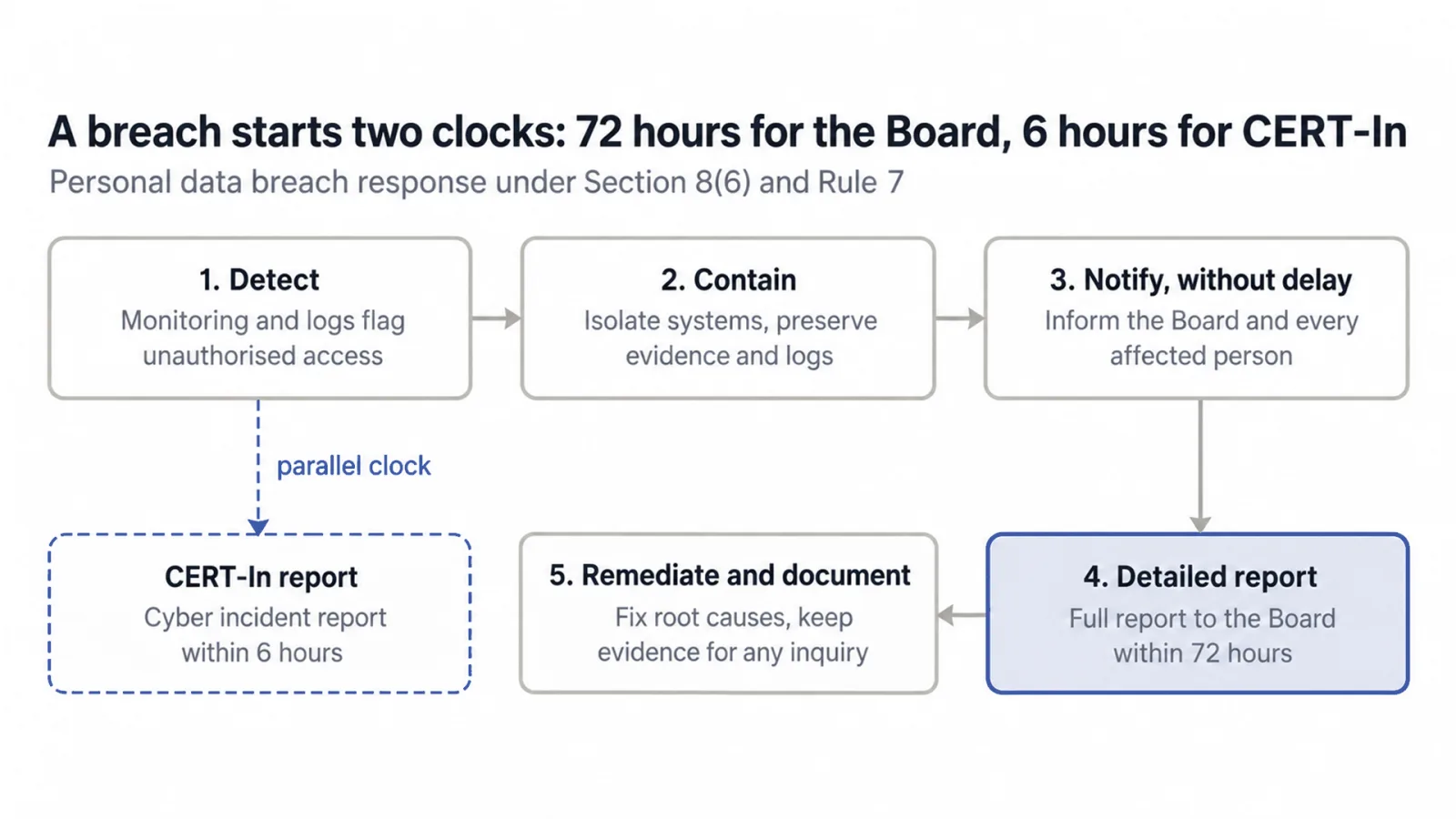
If a personal data breach occurs, the fiduciary must:
- Inform each affected person without delay. Explain what happened, the likely consequences, what you are doing, the safety steps they can take, and who to contact.
- Inform the Data Protection Board without delay with an initial description of the breach.
- Send the Board a detailed report within 72 hours. Cover the facts and causes, mitigation, the person responsible where known, remedial measures, and the notices given to individuals.
Two points surprise most boards. First, DPDP has no materiality threshold: unlike GDPR, every personal data breach must be reported, not only those likely to cause harm. Second, CERT-In’s existing six-hour cyber incident reporting rule continues alongside DPDP. A single incident can therefore trigger two reporting clocks.
You cannot report in 72 hours what you cannot detect. The 72-hour rule is in practice a test of your monitoring, logging and incident response.
6. Children’s Data and Verifiable Parental Consent
Under the DPDP Act, a child is anyone under 18. Processing a child’s data requires the verifiable consent of a parent or lawful guardian. Rule 10 expects the fiduciary to confirm that the person consenting is an identifiable adult, for example through reliable identity details or a virtual token such as DigiLocker. Tracking, behavioural monitoring and targeted advertising aimed at children are prohibited.
Certain classes, such as clinical establishments, educational institutions and childcare providers, have limited exemptions for specific purposes. Schools, edtech platforms, hospitals and consumer brands with young audiences should treat this as a priority. The penalty for breaching children’s data obligations is up to ₹200 crore.
7. Data Principal Rights and 90-Day Grievance Redressal
Individuals have the right to:
- access a summary of their data and how it is processed
- correct, complete, update or erase their data
- have a grievance addressed
- nominate someone to act for them on death or incapacity
You must publish how these rights can be exercised and respond to grievances within 90 days (Rule 14). Where the Act requires it, you must also publish the contact details of a Data Protection Officer or a person who can answer questions about data processing. For most SMEs, the practical need is a simple request intake, an identity check, and a tracker that proves you met the deadline.
8. Vendor and Processor Accountability
You can outsource processing, but not accountability. Every processor must work under a valid contract, and the fiduciary remains liable for the processor’s failures. That covers your cloud host, payroll provider, CRM, email platform, courier partner and IT support vendor.
The IBM 2026 report found supply-chain compromise was the initial attack vector in 15% of Indian breaches. Re-papering vendor contracts with security, breach-notification and erasure clauses is one of the fastest risk reductions available.
Significant Data Fiduciaries: The Additional Duties
| Obligation | All Data Fiduciaries | Significant Data Fiduciaries |
|---|---|---|
| Notice, consent, security, breach reporting, rights | Yes | Yes |
| Published contact for data questions | Yes | Yes, through the DPO |
| Data Protection Officer based in India, reporting to the board | No | Yes |
| Independent data auditor | No | Yes |
| Data Protection Impact Assessment | No | Every 12 months, report to the Board |
| Periodic data audit | No | Every 12 months, report to the Board |
| Due diligence on algorithmic software | No | Yes |
| Localisation of specified data, as notified | No | Yes |
Designations are expected to focus on large technology platforms, banks, insurers and similar high-volume processors. Most SMEs will not be SDFs. Many, however, will be vendors to SDFs, and SDFs will push their audit and security expectations down their supply chains through contracts. Being demonstrably compliant is fast becoming a condition of winning enterprise business.
DPDP Act Penalties: What Non-Compliance Really Costs
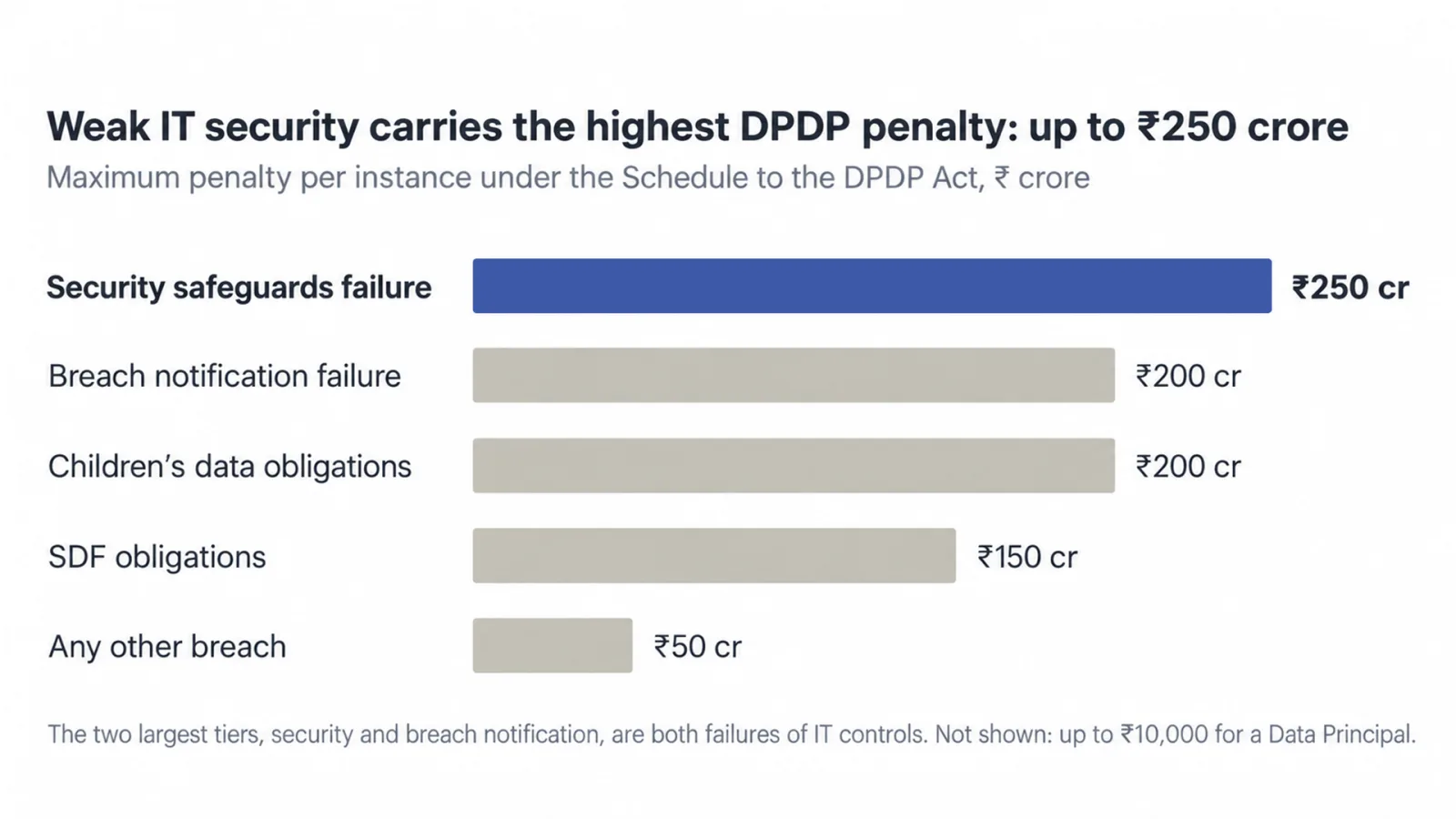
| Violation | Maximum penalty |
|---|---|
| Failure to take reasonable security safeguards to prevent a breach (Section 8(5)) | ₹250 crore |
| Failure to notify the Board or affected persons of a breach (Section 8(6)) | ₹200 crore |
| Breach of obligations for children’s data (Section 9) | ₹200 crore |
| Breach of additional SDF obligations (Section 10) | ₹150 crore |
| Breach of any other provision of the Act or Rules | ₹50 crore |
| Breach of a voluntary undertaking accepted by the Board | Up to the penalty for the underlying breach |
| Breach of duties by a Data Principal (such as a false complaint) | ₹10,000 |
Read the top two rows together. A single ransomware incident can expose a business to ₹250 crore for weak security and ₹200 crore for a late or missing breach report. Both are failures of IT controls, not of legal drafting.
How the Board Decides the Penalty
Under Section 33, the Board weighs:
- the nature, gravity and duration of the breach
- the type and nature of personal data affected
- whether the breach is repeated
- any gain made or loss avoided by the business
- the steps taken to mitigate the effects, and how promptly
- whether the penalty is proportionate and effective
- the likely impact of the penalty on the business
This is where preparation pays. A business that can show encryption, logs, a tested response plan and prompt notification is arguing mitigation from a position of strength. A business that discovers the breach from a customer’s complaint is not.
The Hidden Cost: What a Breach Costs Before Any Penalty
For a CFO, the statutory penalty is only the visible part of the exposure. According to IBM’s 2026 India data, the average Indian breach now costs ₹25.5 crore and compromises 39,500 records. Financial services average ₹40.9 crore per breach. IBM also lists non-compliance with regulations among the top three factors that raise breach costs in India.
Add operational downtime, customer churn, lost tenders, higher cyber-insurance premiums and management time, and the business case changes shape. Compliance spending is not a cost centre. It is insurance against a loss that is now quantifiable.
Why DPDP Compliance Is 70% an IT Problem
Policies don’t stop breaches; controls do. A privacy notice cannot detect an intruder, a consent form cannot encrypt a laptop, and a policy document cannot produce a 72-hour breach report. The Board will not ask whether you had a policy. It will ask what happened, how you found out, and what you had in place to prevent it.
Where Personal Data Actually Lives in an Indian SME
Ask most SME owners where their customer data is, and they will say “in Tally” or “in the ERP”. The honest answer is: everywhere.
- Accounting and ERP systems: Tally, Busy, Marg and ERP databases holding customer, vendor and employee records.
- Email inboxes: invoices, KYC documents, salary slips and CVs sitting in years of attachments.
- Shared drives and desktops: Excel exports of customer lists, dealer databases and payroll sheets.
- Staff laptops and phones: local copies, downloads and WhatsApp media folders.
- USB drives and old backups: forgotten copies that are never encrypted and never erased.
- Vendor systems: payroll providers, CRMs, courier partners and cloud hosts.
Each of these locations is in scope. DPDP compliance therefore starts with data discovery, finding and classifying personal data across systems, and not with drafting.
Shadow IT and GenAI: The Compliance Gap No One Is Mapping
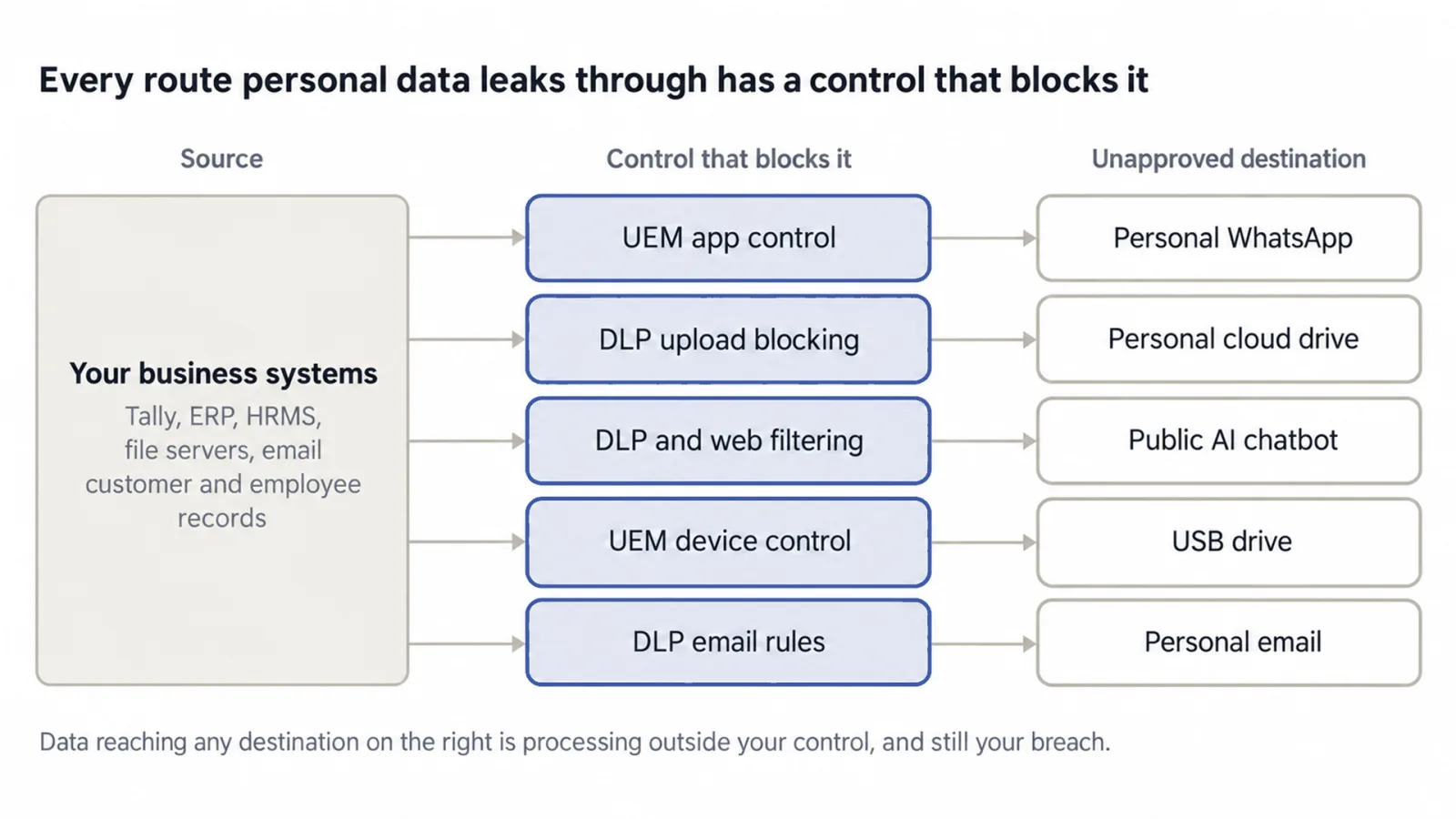
The fastest-growing blind spot is data that leaves your controlled systems through tools IT never approved. An accounts executive forwards a customer list to a personal Gmail to work from home. A sales team runs dealer communication through personal WhatsApp groups. An HR executive pastes a salary sheet into a public AI chatbot to “tidy up the formatting”.
In each case, personal data is now being processed outside your control. There is no processor contract, no log, no access control, and no way to erase it. If that data is exposed, it is still your breach.
The numbers confirm the risk. IBM’s 2026 report found that shadow AI, meaning AI tools used without IT oversight, adds an average of ₹1.79 crore to the cost of a breach in India. The same report found that 26% of malicious breaches in India were AI-generated.
The answer is not to ban AI. It is to govern it:
- an acceptable-use policy that says which tools may handle which data
- Data Loss Prevention (DLP) rules that block uploads of personal data to unapproved websites and personal storage
- Unified Endpoint Management (UEM) to control which applications run on company devices
- web filtering at the firewall for unapproved AI and file-sharing services
- approved, enterprise-grade AI tools covered by proper processor terms
The Attack Vectors DPDP Penalises
IBM’s 2026 India data shows the most common ways breaches begin:
- Phishing, including voice and SMS phishing: 19% of breaches. The defences are email security, MFA and staff awareness.
- Drive-by compromise: 16%. The defences are endpoint protection, patching and web filtering.
- Supply-chain compromise: 15%. The defences are vendor security clauses, access limits and monitoring.
Every one of these is a gap in IT controls. When the Board asks whether your safeguards were “reasonable”, it will be asking, in effect, whether you had these defences in place.
The India Inc Readiness Gap
The surveys show how far most organisations still have to go:
- About 71% of organisations have only a limited understanding of the DPDP Act and Rules (EY).
- Only 48% have started a gap assessment, the most common first step (EY).
- Nearly 80% have not updated their privacy policies or governance frameworks for DPDP (EY).
- More than 83% have not begun end-to-end implementation across systems and processes (EY).
- 75% of enterprises lack a dedicated privacy budget (IDfy and MIT Sloan Management Review India).
These surveys are weighted towards larger enterprises. In my experience, readiness among SMEs is lower still, because most have no dedicated security or compliance function at all.
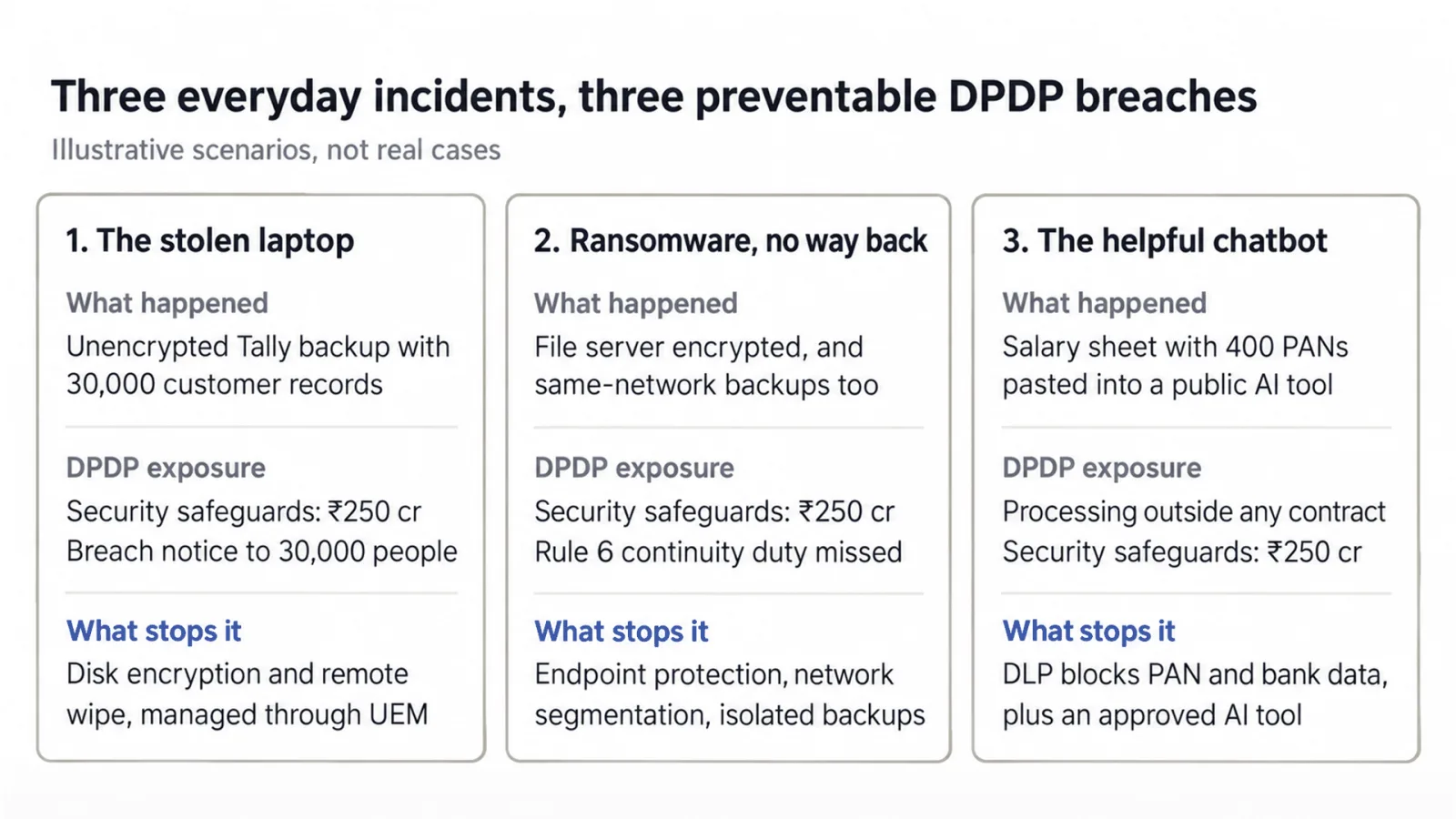
Three Illustrative SME Breach Scenarios
These are illustrative scenarios, not real cases.
Scenario 1: The stolen laptop. An accounts executive’s laptop is stolen from a car. It holds an unencrypted Tally backup with 30,000 customer records, including phone numbers and bank details.
- DPDP exposure: Section 8(5) security safeguards (up to ₹250 crore) and Section 8(6) breach notification to the Board and all 30,000 customers.
- What would have prevented it: full-disk encryption, managed through UEM, with remote wipe. With the data encrypted, the theft becomes a hardware loss rather than a data breach.
Scenario 2: Ransomware with no way back. Ransomware encrypts the file server holding payroll and dealer records. The backups were on a NAS on the same network, so they are encrypted too.
- DPDP exposure: security safeguards, breach notification, and Rule 6’s requirement to maintain continuity through backups.
- What would have prevented it: endpoint detection, network segmentation at the firewall, and offsite or cloud backups isolated from production and tested regularly.
Scenario 3: The helpful chatbot. An HR executive pastes a salary sheet with 400 employees’ names, PANs and bank details into a free AI chatbot to reformat it.
- DPDP exposure: unauthorised processing outside any processor contract, security safeguards, and possible breach reporting. The employment carve-out does not cover this.
- What would have prevented it: DLP policies that detect PAN and bank-account patterns and block uploads to unapproved sites, plus an approved enterprise AI tool.
The DPDP Compliance Stack
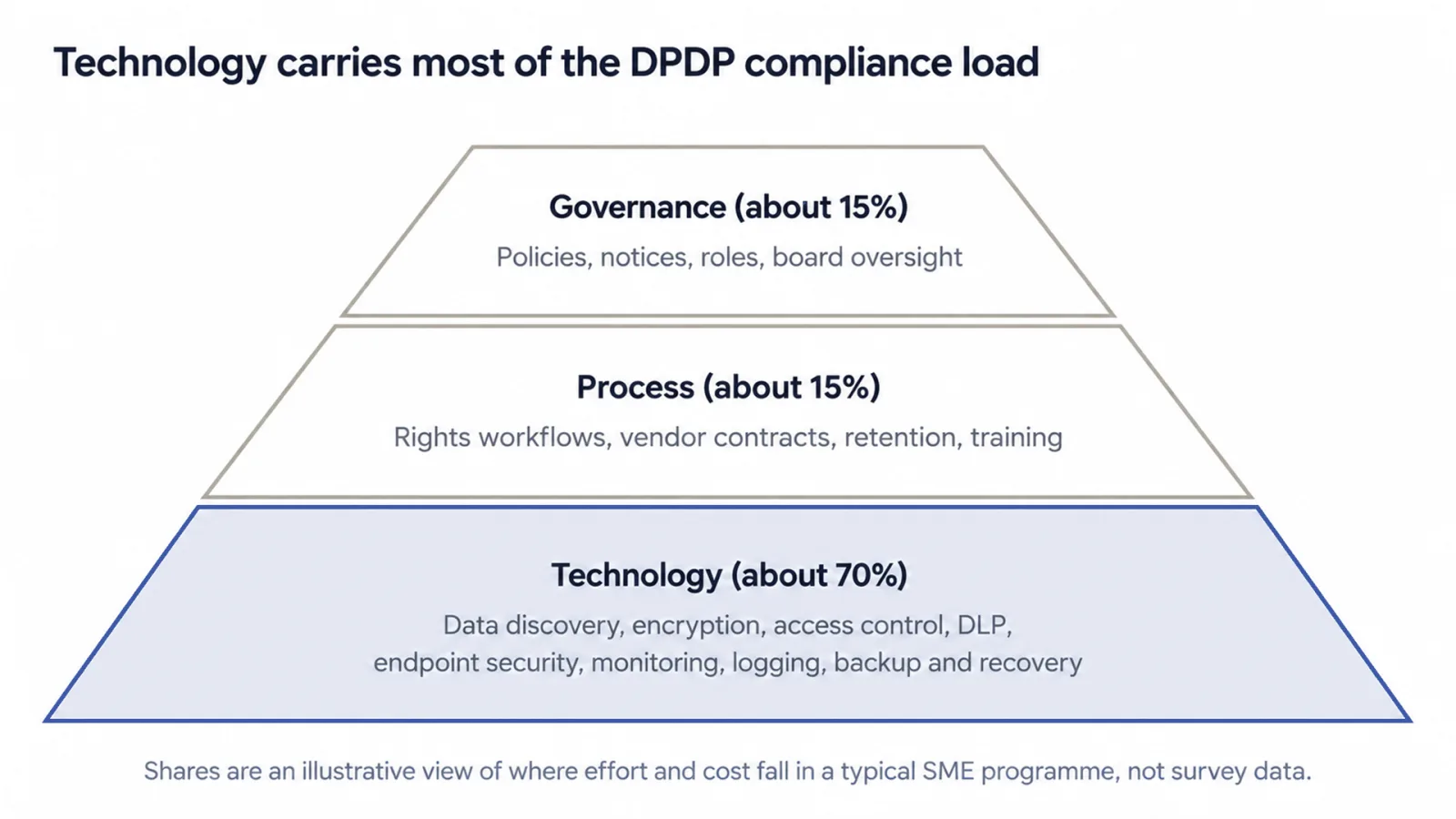
Think of DPDP compliance as three layers. Governance and process matter, but technology carries most of the weight and most of the penalty exposure.
- Governance (about 15%): policies, notices, roles, board oversight.
- Process (about 15%): rights workflows, vendor contracts, retention schedules, training.
- Technology (about 70%): data discovery, encryption, access control, DLP, endpoint security, monitoring, logging, backup and recovery.
The percentages are an illustrative view of where effort and cost fall in a typical SME programme, not survey data.
DPDP Compliance Checklist: A 10-Step Roadmap to May 2027
- Appoint an owner. Name one accountable executive and a small cross-functional group from IT, HR, finance and legal. DPDP fails when it belongs to everyone.
- Map your data. Build an inventory of what personal data you hold, where it sits, who can access it, which vendors receive it, and why you hold it. Use discovery tools rather than surveys alone, because people do not know what is on their laptops.
- Run a gap assessment. Compare current practice against each obligation in the Act and Rules, and rank the gaps by penalty exposure and effort. Start with security and breach response, where the penalties are largest.
- Redesign notices and consent. Rewrite notices to Rule 3’s standard, separate consent by purpose, build a withdrawal mechanism, and send fresh notices for legacy data. Document which processing relies on legitimate uses such as employment.
- Implement the Rule 6 security safeguards. Encryption, access control with MFA, endpoint protection, DLP, centralised logging with one-year retention, and isolated, tested backups. This is the largest workstream and the one to fund first.
- Build and test a 72-hour breach plan. Define who decides, who notifies the Board, who tells customers, and who handles CERT-In’s six-hour report. Run a tabletop exercise before May 2027, not after the first incident.
- Define retention and erasure. Set retention periods by data type, aligned with tax, company and labour law, and make sure erasure reaches backups, archives and vendors.
- Re-paper vendor and processor contracts. Add security standards, breach-notification timelines, audit rights, sub-processor controls and erasure on exit.
- Set up a rights and grievance workflow. Provide a simple intake channel, identity verification and a tracker that evidences responses within 90 days.
- Train staff and audit continuously. Run phishing simulations and DPDP awareness sessions, review access quarterly, and test your controls at least once a year. Keep the evidence, because the Board will ask for it.
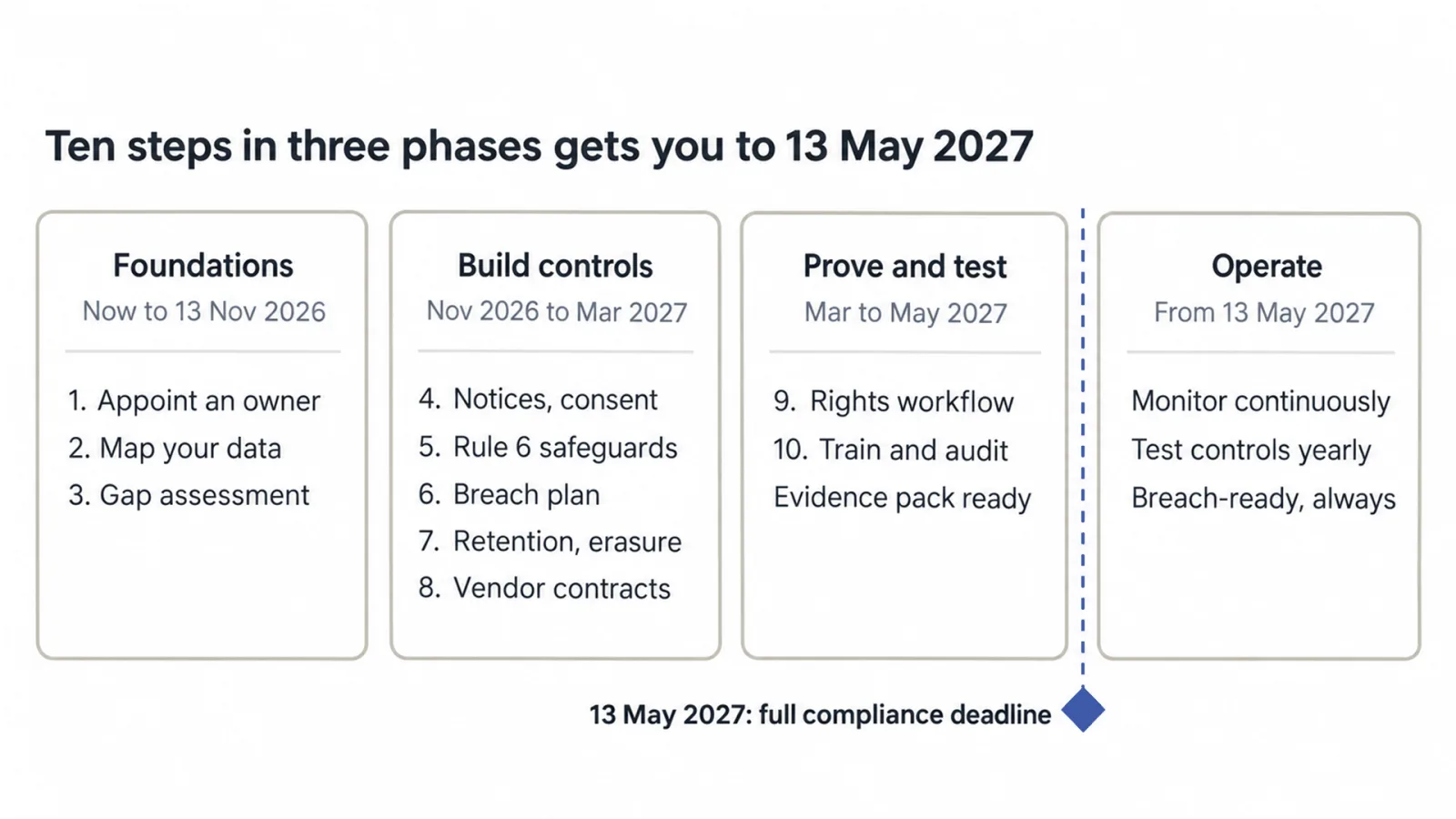
A Phased Plan for the Next Seven Months
| Window | Priorities |
|---|---|
| Now to 13 Nov 2026 | Steps 1–3: ownership, data mapping, gap assessment, consent review |
| 13 Nov 2026 to Mar 2027 | Steps 4–8: notices, security controls, breach plan, retention, vendor contracts |
| Mar to 13 May 2027 | Steps 9–10: rights workflow, training, testing, evidence pack |
| From 13 May 2027 | Monitor, audit and improve continuously |
What to Look For in a DPDP Compliance Solution
The market is filling with tools that claim to make you “DPDP compliant in a week”. Be sceptical. A consent banner does not encrypt a database, and a policy generator does not detect a breach. Evaluate any DPDP compliance solution, or combination of solutions, against these questions:
| Capability | Why it matters | Question to ask the vendor |
|---|---|---|
| Data discovery and classification | You cannot protect what you cannot find | Does it scan endpoints, email and cloud storage, not just databases? |
| Consent and preference management | Notice and consent duties under Rule 3 | Does it keep a time-stamped, auditable consent record? |
| Security controls (DLP, endpoint, encryption) | Rule 6 security safeguards | Are they centrally managed, with policy enforcement on every device? |
| Logging and monitoring | Breach detection and one-year log retention | How long are logs kept, and who reviews the alerts? |
| Backup and disaster recovery | Rule 6 continuity requirement | Are backups isolated from production, and when were they last tested? |
| Data residency | Cross-border transfer risk | Where is the data physically stored? |
| Breach response workflow | 72-hour reporting to the Board | Can it produce the facts needed for the Board report quickly? |
| Evidence and reporting | Proving compliance in an inquiry | Can it produce audit-ready reports on demand? |
For most SMEs, the practical answer is a combination: a legal partner for notices and contracts, a consent tool if you collect data at scale online, and a technology partner who can deploy and run the security, monitoring and recovery controls that make up most of the work.
How HRM Technologies Helps You Get DPDP-Ready
If DPDP compliance is 70% an IT problem, it needs an IT partner. For 25 years, HRM Technologies has helped Indian businesses, from steel plants and transport companies to tax practices, run secure, reliable IT. DPDP turns much of that work from good practice into a legal obligation.
Mapping DPDP Requirements to HRM Services
| DPDP requirement | Reference | IT control | HRM service |
|---|---|---|---|
| Reasonable security safeguards on devices | Sec 8(5), Rule 6 | Endpoint protection, device management, disk encryption, remote wipe | End Point Security, EndPoint Management (UEM) |
| Preventing unauthorised disclosure, including shadow AI | Sec 8(5) | Data Loss Prevention | Data Loss Prevention |
| Network security and web filtering | Rule 6 | Next-generation firewall, intrusion prevention, web filtering | UTM Firewall |
| Continuity and ransomware resilience | Rule 6 | Isolated, tested backups and disaster recovery | Backup & DR Services |
| Encryption and access control for business data | Rule 6 | Secure hosted applications with controlled access | Tally, ERP and CRM on Cloud |
| Secure communications and archiving | Rule 6 | Secure business email, archiving, retention | Google Workspace, Office 365, Mail Vault |
| Log retention and breach detection | Rule 6, Sec 8(6) | Monitoring, alerting, log management | Managed IT Services |
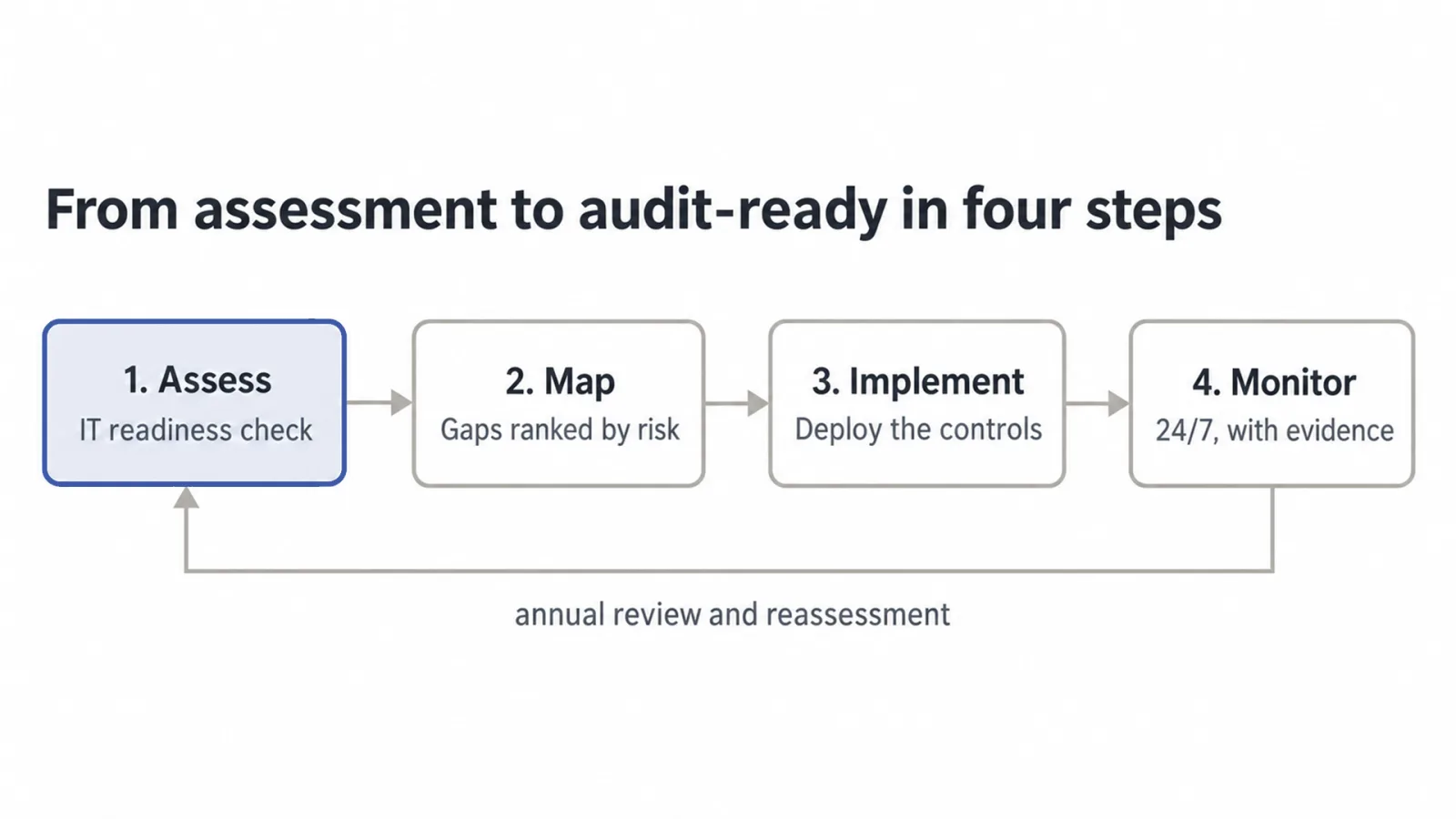
How an Engagement Works
- Consultation and DPDP IT readiness assessment. We map where personal data sits across your servers, endpoints, email, cloud and vendors, and assess your current controls.
- Gap mapping against DPDP. We match each finding to the relevant DPDP obligation and penalty tier, so the CFO sees a prioritised, costed plan rather than a technical wish-list.
- Implementation. We deploy the controls: encryption, DLP, endpoint security, firewall, backup and secure hosting, with minimal disruption to operations.
- Monitoring and ongoing support. We provide proactive monitoring, 24/7 support, regular reviews and the documentation you need to demonstrate compliance to the Board.
Why HRM Technologies
- 25 years in business, serving 2,700+ SME customers across India.
- 85% repeat customers, a measure of trust earned over decades, not campaigns.
- 300+ person-years of combined technical experience.
- Multi-OEM partnerships across cloud, security and backup, so recommendations fit your needs rather than one vendor’s catalogue.
As one client, Samkit Jain, Director at a tyre showroom, put it: “They have solved our data protection issues in quick time.”
A Note on Scope
DPDP compliance needs both legal and technical expertise. HRM Technologies delivers the technology controls and the evidence they generate. Privacy notices, consent wording and contract terms should be prepared with your legal counsel, and we work alongside them to make sure what the documents promise is what your systems deliver.
Conclusion: Start Now, Not in April 2027
The deadlines are already set:
- 13 November 2026: the Consent Manager rules come into force.
- 13 May 2027: every business must be fully compliant with the DPDP Act.
You have about seven months. Starting now gives you time to do this properly.
Here is why it matters:
- A data breach in India costs a business ₹25.5 crore on average.
- The DPDP Act can add a penalty of up to ₹250 crore for weak security.
Getting compliant costs far less than either of these.
You can take three steps this quarter:
- Name one person to own DPDP compliance.
- Map your data. Find out what personal data you hold and where it is stored.
- Check your security controls against the safeguards listed in Rule 6.
Your privacy policy and consent forms matter, and your legal team should get them right. But if something goes wrong, the Data Protection Board will look at what your systems actually did, not just what your documents said.
Ready to find out where you stand? Book a DPDP IT Readiness Assessment with HRM Technologies and get a clear, prioritised plan for DPDP compliance before the deadline.
Book an AssessmentFrequently Asked Questions on DPDP Compliance
1. What is DPDP compliance?
+
DPDP compliance means meeting the obligations of the Digital Personal Data Protection Act, 2023 and the DPDP Rules, 2025 whenever your business collects, uses, stores, shares or deletes digital personal data. In practice, it covers giving clear notices and taking valid consent, protecting data with reasonable security safeguards under Rule 6, reporting breaches within the prescribed timelines, honouring individuals’ rights, and controlling the vendors that process data for you. Compliance is not a one-time certificate. It is an ongoing state that you must be able to demonstrate with evidence, such as logs, consent records, contracts and test results, if the Data Protection Board inquires.
2. When is the DPDP compliance deadline?
+
Most DPDP obligations become enforceable on 13 May 2027, 18 months after the DPDP Rules were notified on 13 November 2025. That date covers notice and consent, security safeguards, breach reporting, retention, children’s data, data principal rights and the additional duties of Significant Data Fiduciaries. The Consent Manager framework under Rule 4 takes effect earlier, on 13 November 2026. In January 2026, MeitY also sought industry views on shortening the window to 12 months, particularly for large data fiduciaries. No final decision had been announced at the time of writing, but businesses likely to be designated as SDFs should plan as if the earlier date could apply.
3. Does the DPDP Act apply to small businesses and MSMEs?
+
Yes. The DPDP Act has no turnover, headcount or data-volume threshold, so any business that processes digital personal data of individuals is covered. That includes a 20-person distributor with a customer list in Tally. Section 17(3) allows the Government to exempt certain classes of Data Fiduciaries, including startups, from some provisions, but such exemptions apply only once notified, and they do not cover the core security duty. Smaller businesses also benefit from the “reasonable” standard: safeguards are judged against your size and the data you hold. That means proportionate controls, not none.
4. Is employee data covered under the DPDP Act?
+
Yes. Employee data is covered, but with an important difference. Section 7(i) treats processing “for the purposes of employment” as a legitimate use, so you do not need consent for payroll, attendance, statutory filings or protecting confidential information. However, the Section 8 duties still apply in full: reasonable security safeguards for HR and payroll systems, breach reporting if employee data is compromised, erasure when the purpose ends, and valid contracts with payroll and HRMS vendors. Employees’ access and erasure rights may be narrower where processing rests on Section 7(i), though grievance redressal still applies. Avoid stretching the employment carve-out to justify intrusive monitoring, which commentators argue it does not cover.
5. What is the penalty for non-compliance with the DPDP Act?
+
The DPDP Act sets a maximum penalty for each type of failure. The main ones are: failing to protect data with reasonable security safeguards, up to ₹250 crore; failing to report a data breach, up to ₹200 crore; failing to meet the rules on children’s data, up to ₹200 crore; failing to meet the extra duties of a Significant Data Fiduciary, up to ₹150 crore; and any other breach of the Act, up to ₹50 crore. These are upper limits. The Data Protection Board decides the actual amount after an inquiry. It looks at how serious the breach was, how long it lasted, what type of personal data was involved, whether the business has made the same mistake before, and how quickly the business acted to limit the damage. The penalty is only part of the cost. According to IBM’s 2026 report, a data breach in India already costs a business ₹25.5 crore on average.
6. Do I need to appoint a Data Protection Officer?
+
Only Significant Data Fiduciaries must appoint a Data Protection Officer. Under Section 10, the DPO must be based in India and responsible to the board or governing body. Other Data Fiduciaries do not need a formal DPO, but they must publish the business contact details of a person who can answer questions about how personal data is processed. For most SMEs, that means designating a senior, named individual, often from IT, compliance or finance, and giving them the authority and resources to run the rights and grievance process. Even when it is not mandatory, a named owner is the single most effective step towards DPDP compliance.
7. How quickly must a data breach be reported under the DPDP Rules?
+
Section 8(6) and Rule 7 mandate that the Data Protection Board and every affected person must be informed without delay once you become aware of a personal data breach. You must then send the Board a detailed report within 72 hours, covering the facts, causes, mitigation steps, remedial measures and the notices given to individuals. Unlike GDPR, there is no materiality threshold, so every personal data breach must be reported. For certain cyber incidents, such as a hack or a ransomware attack, CERT-In’s separate rule also applies. It requires the business to report the incident to CERT-In within six hours. This means a single incident may need to be reported twice: once to CERT-In within six hours, and once to the Data Protection Board within 72 hours. You can only meet these deadlines if you find out about a breach quickly. That depends on having systems that monitor your network and keep a record of who accessed what data, and when.
8. Does the DPDP Act apply to data stored on foreign or cloud servers?
+
Yes. The DPDP Act applies to personal data of individuals in India wherever it is processed or stored, including on overseas cloud servers. Section 16 allows cross-border transfers by default, except to countries the Government restricts by notification. Significant Data Fiduciaries may also face localisation requirements for specified data. Your security duties travel with the data: if your cloud host suffers a breach, you remain the accountable Data Fiduciary. When choosing a cloud provider, check where the data is physically stored, what security certifications the provider holds, and whether your contract includes breach-notification and erasure obligations.
9. What is a Consent Manager under the DPDP Rules?
+
A Consent Manager is a platform registered with the Data Protection Board that lets individuals give, manage, review and withdraw consent across multiple businesses from a single interface. Under Rule 4, which takes effect on 13 November 2026, a Consent Manager must be an Indian company with a minimum net worth of ₹2 crore, and must meet technical, operational and fiduciary standards. Consent Managers act on behalf of individuals, not businesses. Businesses are not obliged to use one, but if a customer withdraws consent through a Consent Manager, the business must honour it. Consumer-facing companies should prepare their systems to receive such requests.
10. How is the DPDP Act different from GDPR?
+
The DPDP Act is simpler than GDPR in structure but strict on enforcement. It has no separate category of sensitive personal data, and it allows processing on only two grounds, consent and specified legitimate uses, against GDPR’s six lawful bases. Penalties are fixed amounts of up to ₹250 crore per instance rather than a percentage of global turnover. Breach reporting is broader, because every personal data breach must be reported to both the Board and affected individuals, with no materiality test. The DPDP Act also covers only digital personal data. A GDPR programme is a useful starting point, but it does not automatically make you DPDP-compliant.
11. How long can a business retain personal data?
+
Under Section 8(7), a business may keep personal data only as long as needed for the purpose for which it was collected, unless another law requires longer retention, such as tax, company or labour law. Once the purpose is served, the data must be erased, including from backups and vendor systems. Rule 8(3) separately requires a minimum one-year retention of personal data, associated traffic data and processing logs for specified purposes such as investigations. Large e-commerce, gaming and social media platforms must also erase data of users inactive for three years, after 48 hours’ notice. Define retention periods by data type and enforce them technically.
12. Can existing customer data collected before the Act still be used?
+
Yes, with conditions. Under Section 5(2), where an individual gave consent before the DPDP Act commenced, you may continue processing that data. However, you must send them a notice that meets DPDP standards as soon as reasonably practicable. It must explain what data you hold, why you hold it, how to withdraw consent and how to complain to the Board. If the individual withdraws consent, you must stop processing and erase the data within a reasonable time, unless a law requires you to keep it. For businesses with years of legacy customer data, this re-notification exercise needs planning, data cleansing and a reliable contact list.
13. What do “reasonable security safeguards” mean in practice?
+
Rule 6 sets the minimum. It covers encryption, masking or tokenisation of personal data, access controls, logging and monitoring to detect unauthorised access, backups to maintain continuity, retention of logs for one year, and security clauses in contracts with processors. In practice, for an SME, that means encrypted laptops and servers, multi-factor authentication, endpoint protection, Data Loss Prevention, a managed firewall, centralised logs, and isolated, tested backups. The standard is “reasonable”, judged against your size and the data you hold, but the penalty for failing it is the Act’s highest at ₹250 crore. These controls are the core of a DPDP compliance solution.
14. Can employees use ChatGPT or other public AI tools with customer or employee data?
+
Not without governance. Using AI is not itself a DPDP violation. The risk comes when staff paste personal data into public AI tools that your business has not approved and has no processor contract with. That data is then processed outside your control, cannot be reliably erased, and may be exposed. If it leaks, the breach is still yours. IBM’s 2026 report found that shadow AI adds an average of ₹1.79 crore to the cost of a breach in India. Set an acceptable-use policy, approve enterprise AI tools with proper data terms, and use DLP to block personal data from reaching unapproved sites.
15. Who enforces the DPDP Act, and can individuals file complaints?
+
The Data Protection Board of India enforces the DPDP Act. It was established in November 2025 as a digital-first body. It can receive complaints from individuals, act on breach intimations and references from the Government, conduct inquiries, issue binding directions and impose penalties. Individuals must first use the business’s own grievance mechanism, which must respond within 90 days, before approaching the Board. Appeals against Board decisions go to the Telecom Disputes Settlement and Appellate Tribunal (TDSAT). For businesses, a responsive internal grievance process is therefore the first line of defence against regulatory complaints.